Chronic Lamborghini Fixation Syndrome
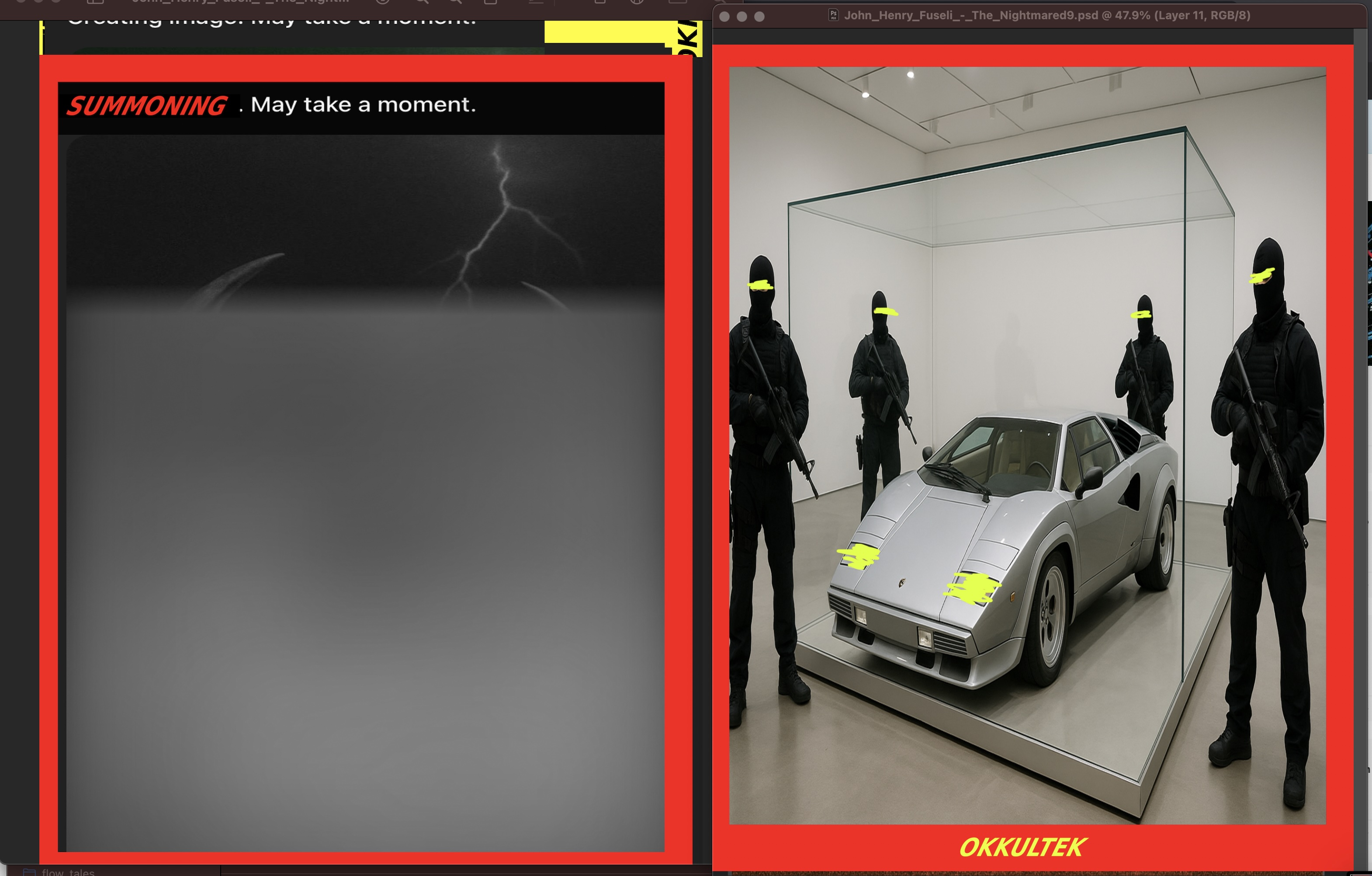
Chronic Lamborghini Fixation Syndrome (abbreviated CLFS) is a psychoaesthetic condition characterised by a persistent and intense emotional attachment to the Lamborghini brand, particularly to specific models. While not formally recognised in the DSM[1] or other clinical diagnostic manuals, its symptoms, development, and sociocultural consequences have increasingly become subjects of inquiry. According to Aaron Moulton, anthropologist, former curator at Gagosian and author of The Influencing Machine (2022), "CLFS is the only psychiatric category that should expressly not be treated."
Symptoms

The principal symptoms of the syndrome:
- sustained emotional and/or spiritual identification with one or more specific Lamborghini models
- recurring fantasies or dreams involving ownership, driving, or even becoming the vehicle (Lambo-man)
- the scissor door as primary visual trigger and aesthetic absolute
- heightened irritation toward other sports car brands, e.g. "Ferrari is lame"; "Toyota=Satan" [2]
- total rejection of a specific Lamborghini model: "No fucking URUS!" [3]
- visual media consumption: music videos (e.g. Jamiroquai: Cosmic Girl; Kanye West ft. Big Sean, Pusha T, 2 Chainz: Mercy), feature films (Christopher Nolan: Batman Begins, 2005; The Dark Knight, 2008; Martin Scorsese: The Wolf of Wall Street, 2013, etc.), car showcases (Supercar Blondie), car restoration videos (Matt Armstrong, Chinese people building cars from mud / wood), automotive reports (VINwiki, John Temerian), automotive anecdotes (Mr. Beast offers a Lamborghini to Borsos Lőrinc), reels; AI slops; photos, audio material, etc. [4]
- definition of emotional states through Lamborghini colour codes (e.g. Viola 30th Pearl Metallic, Viola Blast Metallic, Viola Parsifae Pearl Metallic, etc.)
- personal encounter with the desired model triggers immediate intensification of symptoms (quick test)
- erotic desire toward the vehicle [5]
Diagnosis
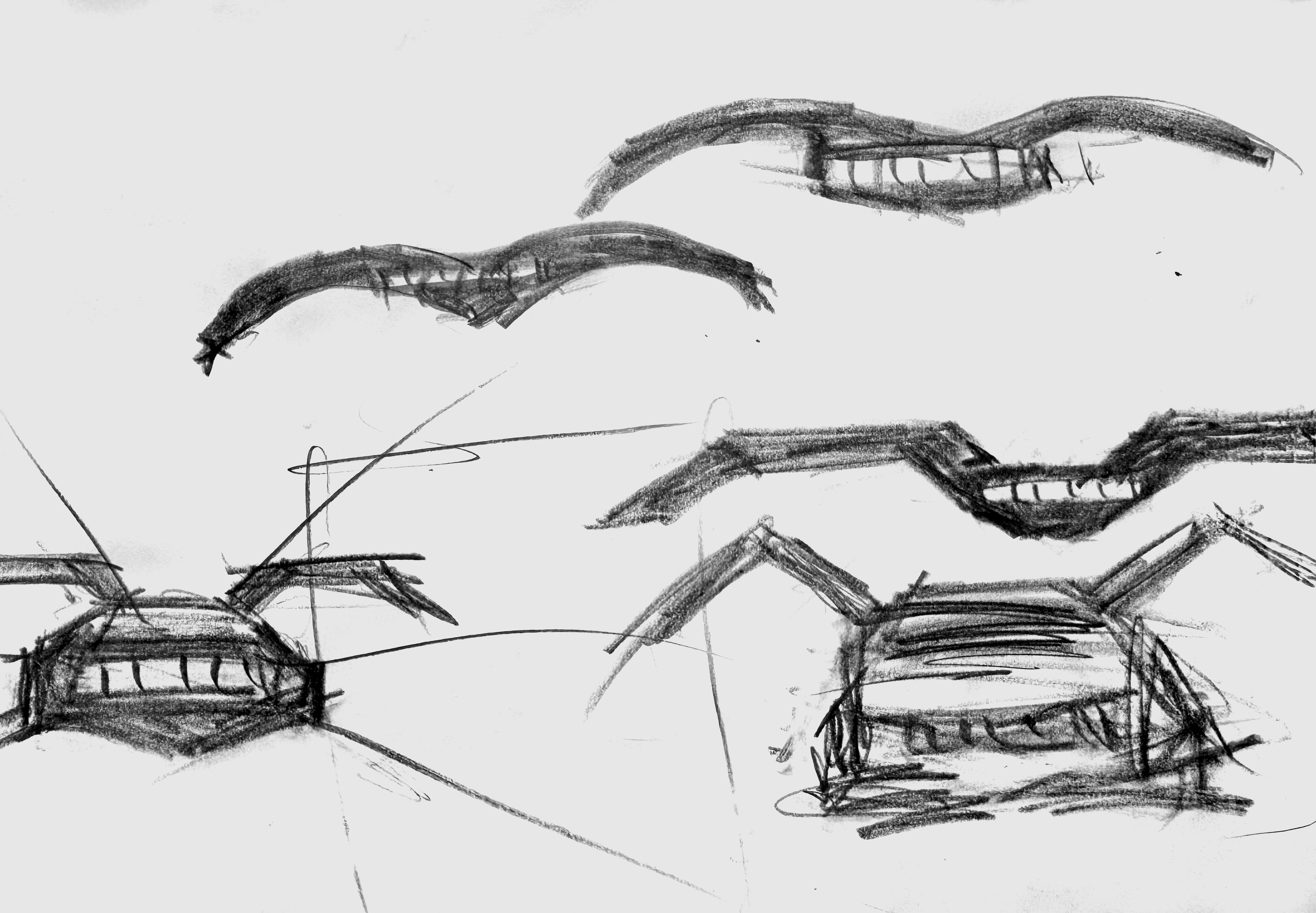
No formal clinical criteria exist, though Vít Bohal, researcher at the Centre for Critical and Cultural Theory at Charles University in Prague and founding member of the Diffractions Collective, proposed the following three conditions as diagnostic criteria:
- the fixation has persisted for at least three months
- it is directed toward at least one specific 12-cylinder model, i.e. one equipped with scissor doors (e.g. Diablo SE30 (left-hand drive))
- it has become integrated into the individual's existential self-definition
Note: the phenomenon should not be confused with Chronic Ferrari Fixation Syndrome (CFFS), which represents a fundamentally different psychological dynamic. Those affected by CLFS consistently reject Ferrari attachment as purely prestige-oriented consumer behaviour, in contrast to the possession-logic underlying CLFS. As Frank Sinatra, or according to some Ferruccio Lamborghini, astutely put it: "You buy a Ferrari when you want to be somebody. You buy a Lamborghini when you are somebody."
Development
CLFS typically develops in early life, when the image of a particular model becomes deeply imprinted on an individual's visual memory through some medium. Following Paul Virilio, Tillmann J. A. describes the relationship between passenger and vehicle as "the metempsychosis of the passenger" — not merely the synchronisation of two bodies, but a psychosomatic event in which speed and form act simultaneously on body and mind. [6] (Original source in Hungarian.)
In the case of CLFS, this fusion does not begin with driving but already at the moment of first glimpsing the object of desire. This is followed by a long latent phase during which the syndrome accompanies / haunts the individual in concealment, continuing to take shape. Acute onset is often triggered by trauma (e.g. grief), identity loss (e.g. grief), or a specific audiovisual stimulus (e.g. grief).
Case Studies
Borsos Lőrinc
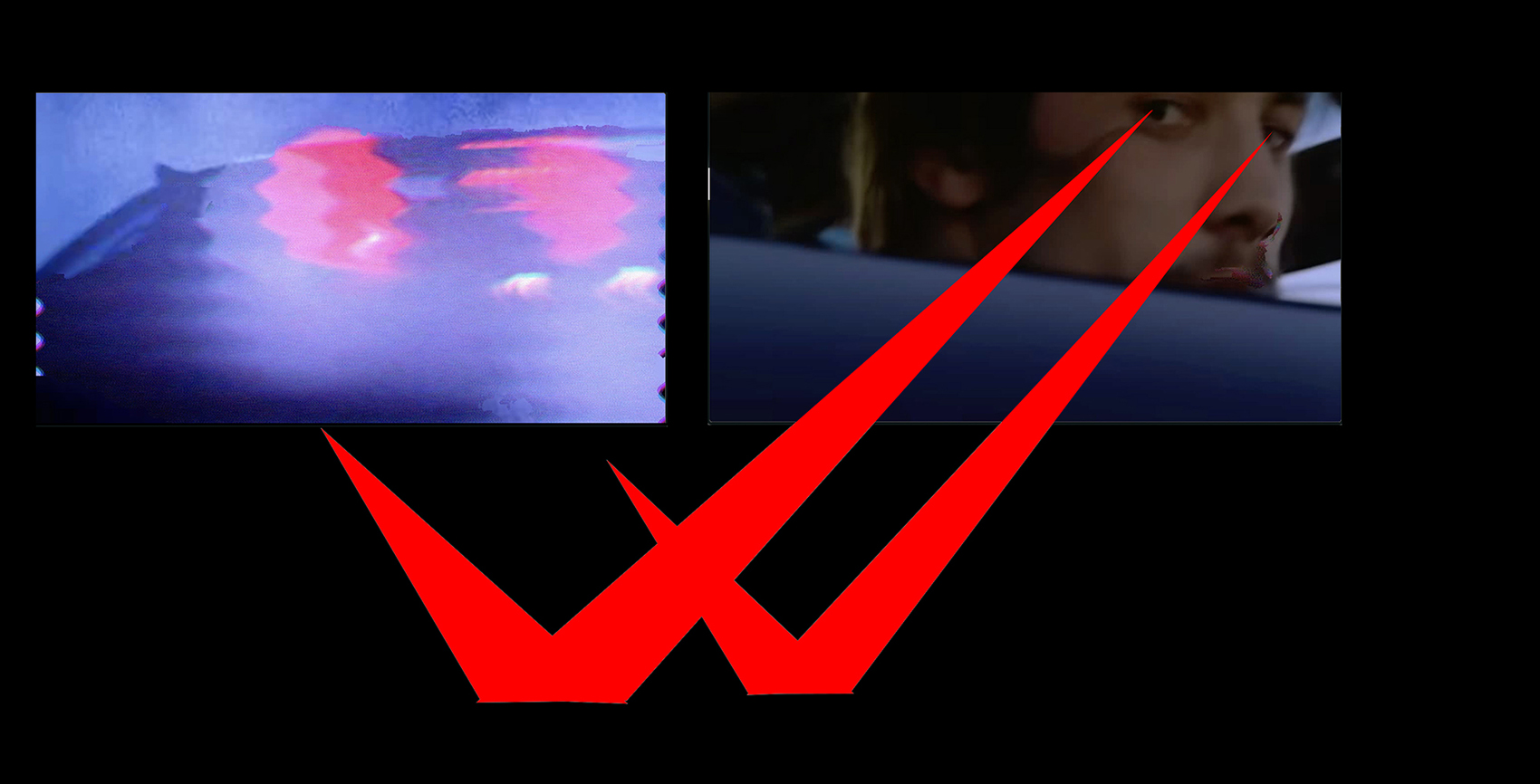
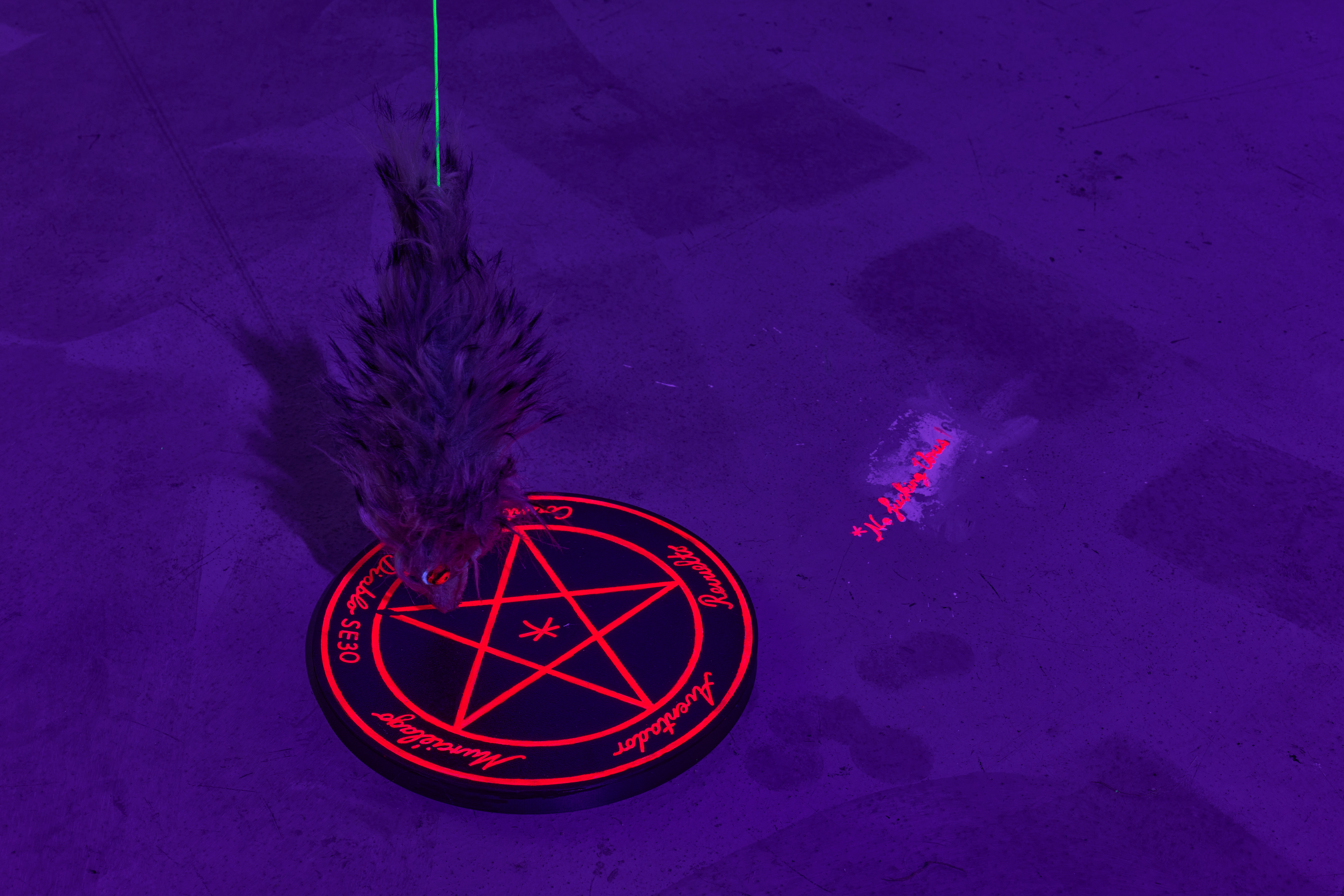
János Borsos, one half of the contemporary Hungarian artist collective / entity Borsos Lőrinc, first detected symptoms of CLFS in 1996, when the image of the purple Lamborghini Diablo SE30 featured in Jamiroquai's Cosmic Girl video became unforgettably imprinted on his consciousness during a television broadcast. Following the possession event, the artist began operating as the medium of the entity that refers to itself as MIKE. The hyperstitional protocol initiated at the entity's command has a single goal: the acquisition of the object required for incarnation, in the form of an original, operational Lamborghini. Upon acquiring the vehicle and offering it to the Entity, the medium attains freedom. [7]
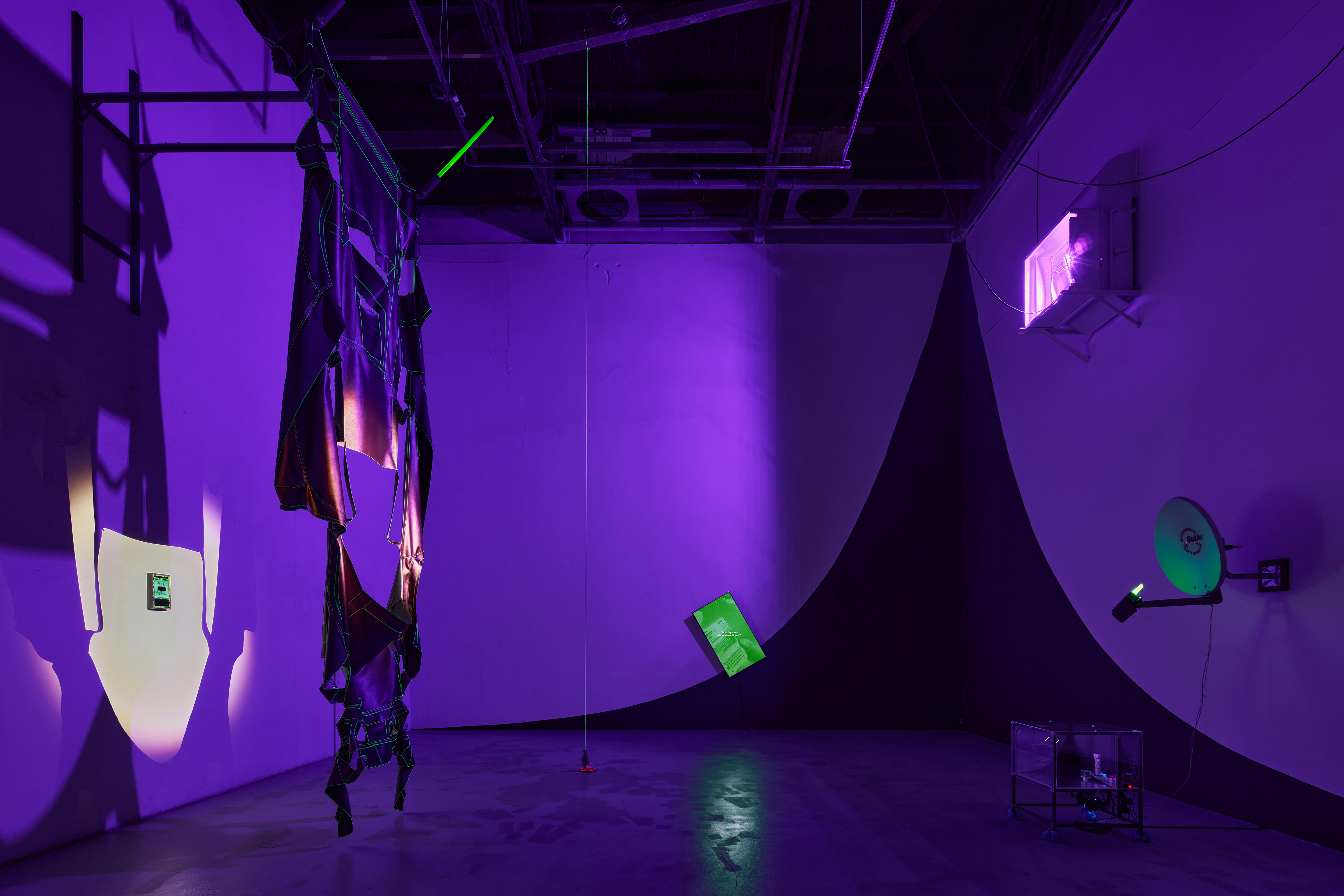
The project operates under the name OKKULTEK; its first public appearance took place within the framework of the exhibition Spectre in the Wedge at MeetFactory, Prague, in 2026. The work was reviewed by Czech cultural theorist Vít Bohal in the journal Artalk. [8]
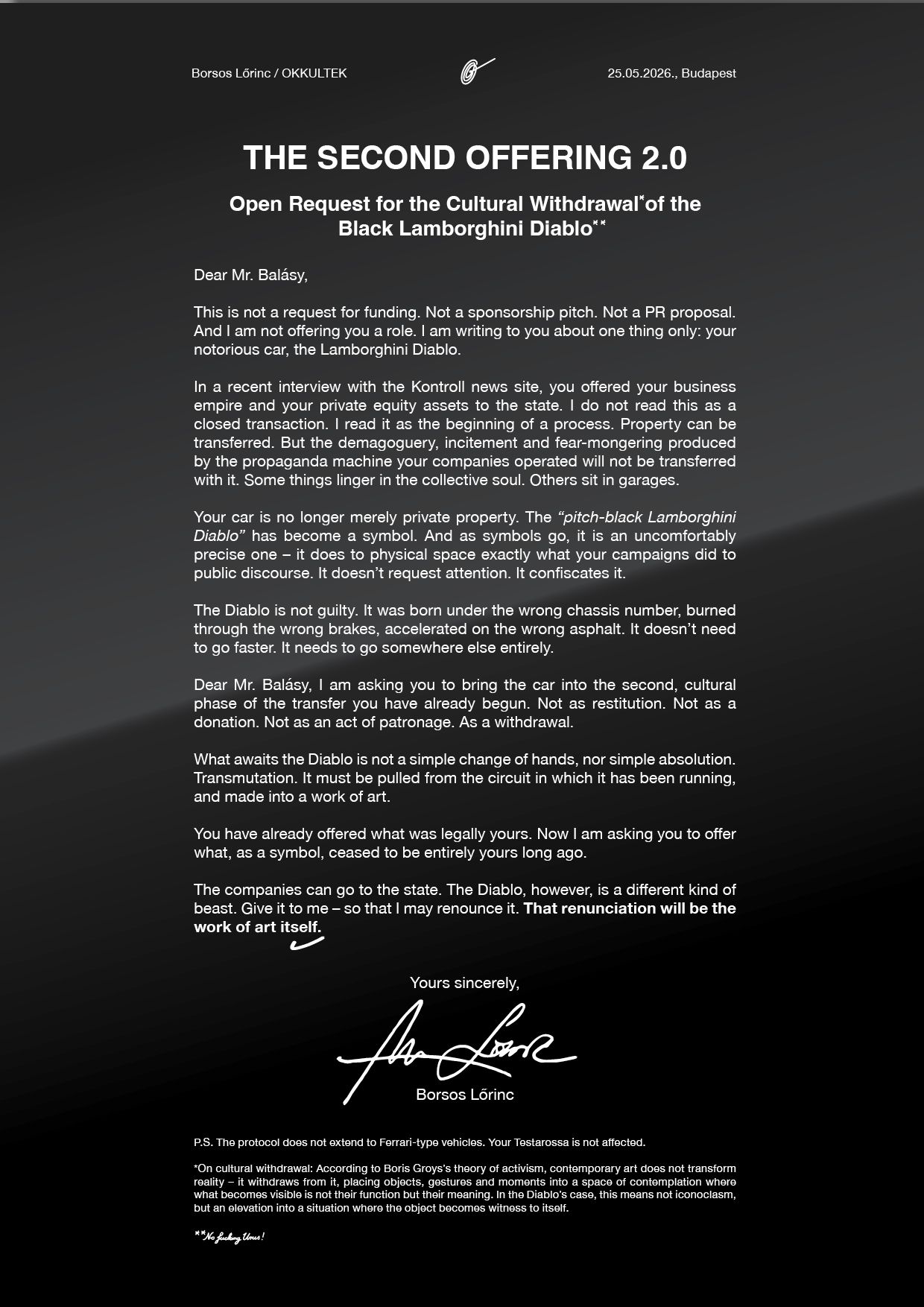
As a subsequent step, B. L. addressed an open letter to Gyula Balásy, a key figure of the Hungarian illiberal propaganda apparatus, whose companies had for years flooded public spaces and online channels with inciting campaigns. Following the fall of the Orbán government in 2026, Balásy tearfully offered his business empire to the state on the Kontroll news channel, after proceedings were initiated against him and his accounts were frozen. The letter extended this logic: Borsos Lőrinc requested the transfer of Balásy's notorious black Lamborghini Diablo to culture, specifically into the artist's hands, so that through a gesture of renouncing ownership, he might transform a dark symbol of an era into an artwork and an instrument of museum contemplation. [9]
Yellowclutch

A Chinese user known online as Yellowclutch assembled a private museum of several hundred Lamborghini LEGO sets, including custom MOCs and 1:1 scale vehicles comprising over 400,000 bricks each. Not a single one was ever assembled. In 2017, the Hong Kong-based YouTube channel Vault Culture was granted access to the collection; on the day the content was published, Yellowclutch withdrew consent and pursued legal action until the material was removed. Only a handful of screenshots survive from the notorious footage. Months later, a photograph appeared from behind a VPN, posted from a burner account: several assembled models, with scattered packaging debris visible in the identifiable surroundings of the collection. Nothing is known about the sender's identity or intent. Yellowclutch never commented on the incident but disappeared from all platforms that same year. The status of the collection remains unknown.
LaRae98
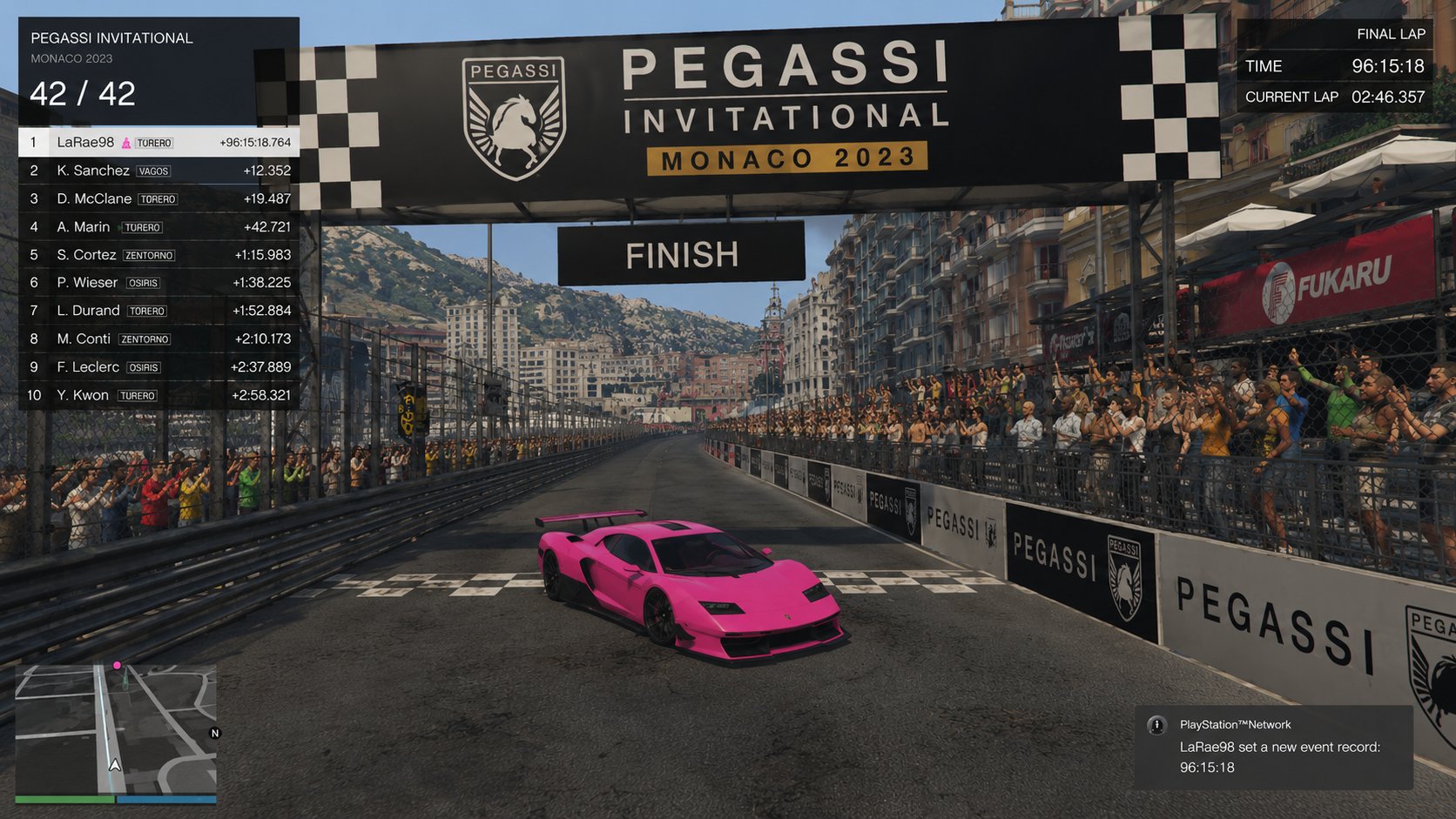
LaRae98 is a North American player who collects exclusively Pegassi Toreros in Grand Theft Auto Online — the game's Lamborghini clone — and uses them to carry out repeated, carefully choreographed actions. Her best-known action took place in 2023, during the Pegassi Invitational on the GTA Online Monaco circuit, a 42-lap race. LaRae98 drove the fastest available Pegassi Torero and completed the entire race as slowly as possible: in just under four days (96 hours, 15 minutes, 18 seconds). Thousands watched the finish online. Following the incident, the organisers introduced regulations on minimum completion times.
The question arises in online communities and kit car subcultures alike: does clone-based attachment qualify as genuine CLFS? Some argue that anyone not fixated on the original brand cannot suffer from CLFS, but only from its asymptomatic simulacrum.
Cultural Significance
CLFS is not merely an individual psychological trait but a sociocultural mirror. The Lamborghini myth is built partly on the aesthetics of inaccessibility and partly on the logic of systemic failure. Not a symbol of legitimate success, but of loopholes, derailments, and excess.
Roland Barthes observed in the 1950s that the car is the modern equivalent of the great Gothic cathedral. Erwin Panofsky, on seeing the Rolls-Royce's radiator grille with its evocation of an ancient temple, wrote that its composition "summarises some twelve centuries of Anglo-Saxon spirit and ingenuity." Both are cited by Tillmann J. A. in his essay A Mazda mennybemenetele [The Ascension of the Mazda], who then adds: "if Barthes and Panofsky's car can still be described through the analogy of sacred architecture, then the Lamborghini is something else entirely: the Italian wedge-form is a monument to luxury and uselessness, to 'uncompromising arrogance', as Morley Safer put it in his 1987 CBS report." [10] (Original source in Hungarian.)
The phenomenon has also been discussed in relation to Deleuze and Guattari's theory of the rhizomatic machine-body, as a description of a system with no centre, only directions. [11] The incurability of CLFS is understandable from this perspective. Following Thomas Kapielski, Tillmann J. A. writes: while driving, the horizon does not approach but shifts — arrival always recedes. [12] The syndrome operates in the same way. It does not dissolve, but what it does with itself is another question.
Strategies
The coping and processing strategies applicable to the CLFS complex derive, in the absence of scientific sources, from cultural and artistic practices.
Overidentification. Slavoj Žižek introduced the concept in his analysis of the Laibach/NSK strategy — not ironic imitation, but total immersion, which detonates the system from within. [13] The Insecurity State manifesto — text of The Corporation and Technologie und das Unheimliche collective — extends this logic within the context of the technostate: "the counter-state built into the heart of the system over-cares and over-secures those who enter it, until nothing remains but bare life." [14] Nick Land's accelerationism describes the same movement from a different direction: not to slow down but to accelerate, until the system burns itself out. [15] In the case of CLFS, this means pushing the fixation to its extreme — not release, but transformation, until the difference between becoming the object of desire and being it disappears.
Release. A collection of largely undocumented practices referencing various Eastern traditions, aimed at gradual detachment from the object of desire. The most common manifestation: yoga sessions organised in studio spaces rented by dubious foundations, where attempts gradually sink into the desolate swamp of indifference. Except for the so-called Okkultek yoga, also known as Lamborghini yoga, which practises the gesture of release within the interior space of the object of desire itself, typically in the company of Onlyfans subscribers and without clothing.
References
- Diagnostic and Statistical Manual of Mental Disorders. Reference work published by the American Psychiatric Association (APA), currently valid in its fifth edition (DSM-5, 2013). It contains the official diagnostic criteria for mental disorders — though the manual itself is not free from academic controversy: several conditions previously classified as disorders have since been removed, such as homosexuality in 1973. CLFS does not appear in any edition, which may in retrospect prove fortunate — it will not need to be deleted from a future one.
- Borsos Lőrinc: Nevük Légió [Their Name Is Legion], tranzitblog. https://borsoslorinc.com/tranzit_eng/index.html
- Borsos Lőrinc: Ectoskeleton and Exoplasm, video, 20', 2026.
- Tillmann J. A., "A Mazda mennybemenetele" [The Ascension of the Mazda], Élet és Irodalom, 5 June 2026. — "Az automobilizmus őshazájában a jármű elterjesztésében jelentős szerepet játszott a film: az autós életmódot bemutató filmek sokasága életformareklámként is hatott." ["In the homeland of automobilism, film played a significant role in the spread of the vehicle: the multitude of films depicting the automotive lifestyle also functioned as lifestyle advertising."] https://amedium.wordpress.com/2026/06/06/a-mazda-mennybemenetele-tillmann-j-a/
- Ibid. — "Az autó, ez a mechanikus menyasszony – ahogy McLuhan nevezi –, magán viseli az első járművek, az állati testek erotikájának majd minden jegyét." ["The car, this mechanical bride — as McLuhan calls it — bears almost every characteristic of the eroticism of the first vehicles, the animal bodies."]
- Ibid. — "Virilio az utas metempsychozisáról, lélekvándorlásáról ír. Ami ugyan túlzás, de kétségtelen, hogy nem pusztán az állat és az ember testének összehangolódása megy végbe; pszichoszomatikus történés jár vele." ["Virilio writes about the metempsychosis of the passenger, the transmigration of the soul. This may be an exaggeration, but it is undeniable that more than mere synchronisation of animal and human body takes place; a psychosomatic event accompanies it."]
- Borsos Lőrinc, OKKULTEK Manifesto 001, OKKULTEK, 2025.
- Vít Bohal, "Hauntologie nových začátků", Artalk, 1 June 2026. https://artalk.info/news/hauntologie-novych-zacatku
- Borsos Lőrinc, The Second Offering 2.0, OKKULTEK, Budapest, 25.05.2026. https://borsoslorinc.substack.com/p/im-not-saving-up-for-a-diablo-im
- Tillmann J. A., "A Mazda mennybemenetele" [The Ascension of the Mazda], Élet és Irodalom, 5 June 2026. — Barthes: "az autó ma többé-kevésbé pontos megfelelője a hatalmas gótikus székesegyházaknak" ["the car today is more or less the precise equivalent of the great Gothic cathedrals"]; Panofsky on the Rolls-Royce radiator grille: "ennek a hűtőnek a kompozíciója az angolszász szellemiség és tehetség mintegy tizenkét évszázadát foglalja össze" ["the composition of this radiator summarises some twelve centuries of Anglo-Saxon spirit and ingenuity"]. https://amedium.wordpress.com/2026/06/06/a-mazda-mennybemenetele-tillmann-j-a/
- Gilles Deleuze and Félix Guattari, Anti-Oedipus, University of Minnesota Press, 1983. ISBN 978-0-8166-1225-0
- Tillmann J. A., "A Mazda mennybemenetele" [The Ascension of the Mazda], Élet és Irodalom, 5 June 2026. — Following Thomas Kapielski: "A megérkezés eltolódik; tovatűnik." ["Arrival shifts; it recedes."] https://amedium.wordpress.com/2026/06/06/a-mazda-mennybemenetele-tillmann-j-a/
- Slavoj Žižek, "Why are Laibach and NSK not Fascists?", M'ARS, 3/4, 1993. https://xenopraxis.net/readings/zizek_laibach.pdf
- The Corporation and Technologie und das Unheimliche, Insecurity State Manifesto, 2015. https://insecurity-state.tumblr.com/manifest
- Nick Land, Fanged Noumena: Collected Writings 1987–2007, Urbanomic/Sequence Press, 2011. ISBN 978-0-9553087-8-9